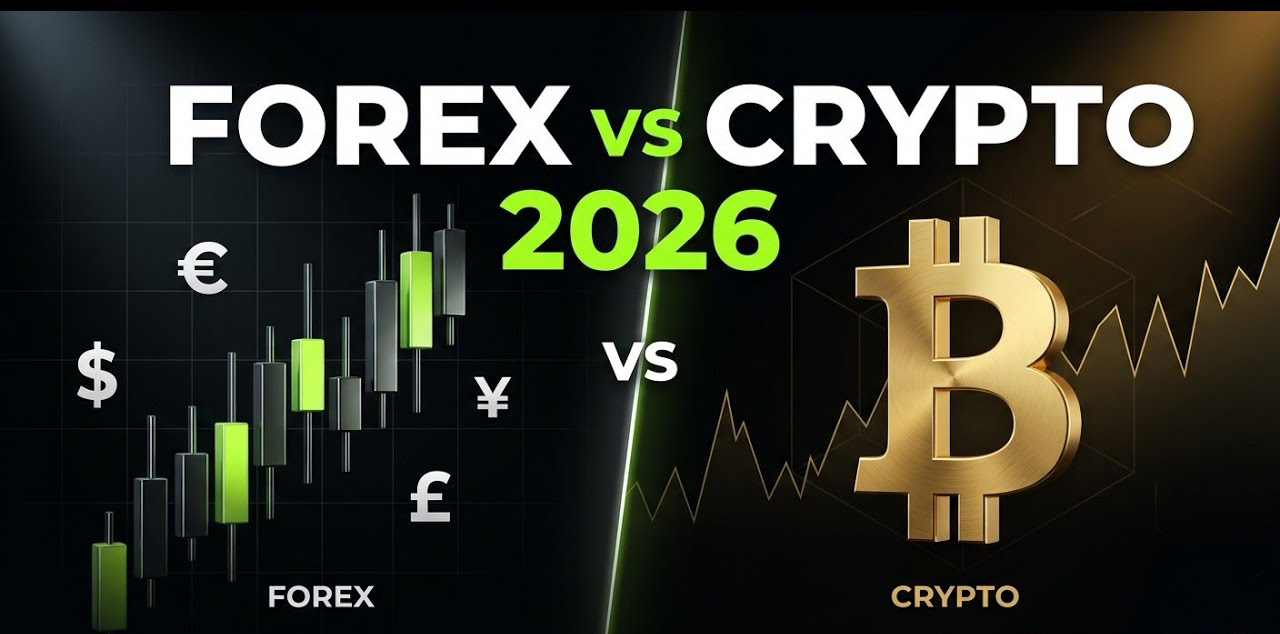
Choosing between a and a is not a question of which market is better — it is a question of which cost structure and which protections match your strategy. A forex broker sells you leveraged access to currency, index and commodity CFDs under a financial regulator. A crypto exchange sells you spot and derivatives access to digital assets, usually under a lighter regime, with the asset custody question attached.
Here is how the two compare on the five things that actually change your P&L, and how to shortlist inside each.
The structural comparison
| Forex broker | Crypto exchange |
|---|
| FX, metals, indices, energy, share CFDs | Spot crypto, perpetual futures, options |
| Spread plus commission per lot | Maker/taker fee in basis points |
| 1:30 in regulated retail regions, up to 1:2000 offshore | 10x to 125x on derivatives |
| FCA, ASIC, CySEC, BaFin, FSCA and equivalents | Varies widely by jurisdiction |
| Broker holds cash, ideally segregated | You hold coins, or the exchange does |
| 24/5 | 24/7 |
The two biggest practical differences are and . A 24/7 market removes the weekend gap but also removes the enforced break; exchange custody means a platform failure is an asset loss, not just a cash claim.
Choosing a forex broker
The four numbers that matter
- A "from 0.0 pips" headline is the best-case raw spread on EURUSD at peak liquidity. What matters is the average spread on the pair you trade at the hour you trade it.
- , since raw-spread accounts move cost from the spread into commission. Compare total round-turn cost, never spread alone.
- ECN or DMA routing versus market making changes fill quality on fast markets far more than a 0.1 pip spread difference.
- FCA, ASIC, CySEC and BaFin licences carry client-money segregation and dispute processes. Offshore entities offering 1:2000 usually do not.
Brokers on our directory
| Broker | Regulation | Spread from | Max leverage | Min deposit |
|---|
| IC Markets | ASIC, CySEC, FSA | 0.0 pips | 1:1000 | $200 |
| Pepperstone | ASIC, FCA, CySEC, BaFin | 0.0 pips | 1:500 | $0 |
| FP Markets | ASIC, CySEC | 0.0 pips | 1:500 | $100 |
| Exness | FCA, CySEC, FSCA, FSA | 0.0 pips | 1:2000 | $10 |
| XM Group | ASIC, CySEC, FSC, DFSA | 0.6 pips | 1:1000 | $5 |
For , the shortlist is driven by raw spreads, commission and platform latency: IC Markets and Pepperstone both list 0.0 pip raw spreads with cTrader and TradingView support, which is the standard combination for high-frequency intraday work. For , the low minimum deposits at XM Group and Exness reduce the cost of finding out whether you like it.
The full field is on the forex broker directory.
Choosing a crypto exchange
What to compare
- , and the tier schedule. On a high-frequency strategy the fee tier is the strategy.
- , not exchange-wide volume. Slippage on a thin altcoin perpetual dwarfs any fee difference.
- — 125x is a marketing figure, not a risk plan.
- The historical risk in crypto has been counterparty failure, not price.
- , which determines whether you can actually use the product and get fiat out.
Exchanges on our directory
| Exchange | Founded | Max leverage | Best known for |
|---|
| Binance | 2017 | 125x | Deepest liquidity and broadest market list |
| Bybit | 2018 | 100x | Derivatives matching speed and copy trading |
| OKX | 2017 | 100x | Institutional liquidity and Web3 integration |
| Kraken | 2011 | 50x | Long security record and EUR/USD fiat rails |
| Coinbase | 2012 | 10x | Regulated custody and compliance |
Compare the full list on the crypto exchange directory.
Which one should you use?
| If you... | Use |
|---|
| Scalp majors during London or New York | A raw-spread ECN forex broker |
| Want regulated protection on your cash | A forex broker under FCA, ASIC or BaFin |
| Trade around the clock and want weekend markets | A crypto exchange |
| Hold assets rather than positions | A crypto exchange with strong custody |
| Want to trade both without a large deposit | A multi-asset prop firm |
That last row is worth taking seriously. FundedNext and Funding Pips cover forex, indices and crypto inside one evaluation, which caps your downside at the fee rather than the deposit. The trade-off is rules — start with what is a prop firm.
Red flags in both categories
- 1:2000 and 125x are risk transfer, not opportunity.
- Check which legal entity your account is actually opened under.
- described repeatedly in public reviews. Deposits are always easy; withdrawals are the test.
- until a volume target is met.
- If total round-turn cost is not findable in two minutes, that is the answer.
Frequently Asked Questions
What is the best forex broker for scalping?
Scalping needs the lowest total round-turn cost and stable execution, which points to raw-spread ECN accounts. On our directory IC Markets, Pepperstone and FP Markets all list spreads from 0.0 pips with cTrader and TradingView support. Compare commission per lot as well as spread, and test fill quality in your own session before committing size.
Is a crypto exchange safer than a forex broker?
Generally no. Regulated forex brokers under the FCA, ASIC, CySEC or BaFin are required to segregate client money and belong to dispute-resolution schemes. Most crypto exchanges operate under lighter regimes, so the counterparty risk sits with you — which is why proof of reserves and withdrawal history matter more there.
How much leverage should I actually use?
Far less than the maximum offered. Position size should be set by the distance to your stop and a fixed percentage of account risk, typically 0.5-1%. High maximum leverage only means a smaller margin requirement; it never means a larger position is a good idea.
Can I trade crypto with a prop firm instead of an exchange?
Yes. FundedNext, Funding Pips and FTMO all list crypto instruments in their programmes, though leverage on crypto is capped much lower than on forex — 1:3 at FTMO. You trade the firm's capital under its drawdown rules rather than holding coins, so it is a different risk profile entirely.
Do I need a broker if I trade with a prop firm?
No. The prop firm provides the trading environment and the platform. A personal broker account is still worth keeping for testing strategies without rule constraints, and for the periods between funded accounts.
 Marcus Vance